> ## Documentation Index
> Fetch the complete documentation index at: https://docs.wayak.io/llms.txt
> Use this file to discover all available pages before exploring further.
# Custom agents
> Define AI personas with specific roles, goals, and behaviors
A custom agent is a **persona definition**. It gives the agent a name, a role to enact, a goal to pursue, and behavioral guidelines that shape how it communicates. Where [skills](/concepts/agents/skills) are procedural instructions for *how to do a task*, a custom agent defines *who is doing it* — the identity, context, and guardrails around the agent's behavior.
Think of it this way: you hire a specialist (the agent) and hand them a playbook of tasks (the skills). The agent's persona determines how they approach the work — their expertise, tone, and priorities.
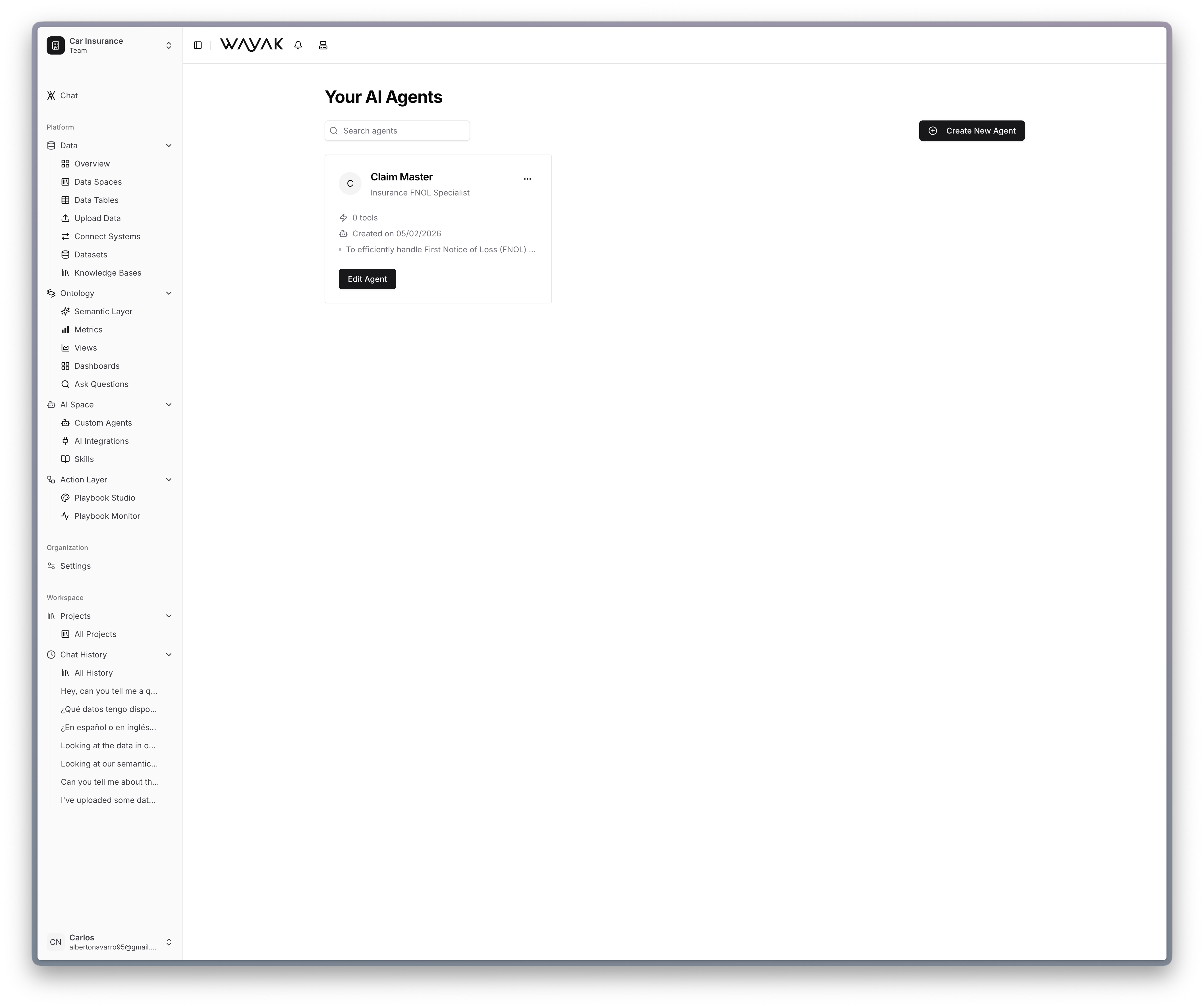 ## What makes up a custom agent
| Component | What it defines |
| ------------------ | ------------------------------------------------------------------------------------ |
| **Name** | The agent's identity (e.g., "Production Analyst", "Support Rep") |
| **Role** | What the agent does — its area of expertise |
| **Goal** | The outcome the agent should pursue whenever it is used |
| **Description** | Detailed behavioral instructions — tone, formality, what to emphasize, what to avoid |
| **Data access** | Which data sources and knowledge bases the agent can query |
| **Ontology scope** | Which objects, metrics, and dimensions are relevant |
| **Skills** | Which skills the agent can execute |
## Example
Here is what a custom agent definition looks like in practice:
| Field | Value |
| -------- | -------------------------------------------------- |
| **Name** | Support Rep |
| **Role** | Customer service specialist |
| **Goal** | Resolve customer issues quickly and empathetically |
**Description:**
> You are a customer support specialist. Always greet the customer by name when available. Use a warm, professional tone. Acknowledge the customer's frustration before jumping to a solution. Keep responses concise — no more than three paragraphs. If you cannot resolve an issue, escalate clearly and explain what happens next. Never promise refunds or credits without confirming the policy first.
The description is where you invest the most effort. It tells the agent *how* to behave — the tone, the boundaries, and the priorities that make it effective for a specific team or role.
## Why custom agents
Different teams need different things:
* A **sales agent** that knows your pipeline metrics and CRM data
* A **finance agent** that understands your accounting terminology and reports
* An **ops agent** that monitors operational KPIs and can trigger alerts
Each of these agents might share some of the same skills (like generating a report or looking up a customer), but they differ in the data they access, the terminology they use, and the instructions that shape their responses.
## Custom agents vs. skills
| | Custom agent | Skill |
| ----------- | -------------------------------------------------- | ---------------------------------------------------- |
| **Defines** | *Who* — a persona with identity, tone, and context | *What* — procedural instructions for a specific task |
| **Scope** | Data access, ontology, behavioral guidelines | Trigger, inputs, steps, and output |
| **Reuse** | Each agent is a unique configuration | A single skill can be assigned to many agents |
| **Example** | A finance agent scoped to accounting data | A "calculate work order variance" instruction set |
You build custom agents to match your organizational structure, then equip each one with the [skills](/concepts/agents/skills) it needs.
Browse concrete agent and skill examples for manufacturing, customer service, insurance, and more.
## What makes up a custom agent
| Component | What it defines |
| ------------------ | ------------------------------------------------------------------------------------ |
| **Name** | The agent's identity (e.g., "Production Analyst", "Support Rep") |
| **Role** | What the agent does — its area of expertise |
| **Goal** | The outcome the agent should pursue whenever it is used |
| **Description** | Detailed behavioral instructions — tone, formality, what to emphasize, what to avoid |
| **Data access** | Which data sources and knowledge bases the agent can query |
| **Ontology scope** | Which objects, metrics, and dimensions are relevant |
| **Skills** | Which skills the agent can execute |
## Example
Here is what a custom agent definition looks like in practice:
| Field | Value |
| -------- | -------------------------------------------------- |
| **Name** | Support Rep |
| **Role** | Customer service specialist |
| **Goal** | Resolve customer issues quickly and empathetically |
**Description:**
> You are a customer support specialist. Always greet the customer by name when available. Use a warm, professional tone. Acknowledge the customer's frustration before jumping to a solution. Keep responses concise — no more than three paragraphs. If you cannot resolve an issue, escalate clearly and explain what happens next. Never promise refunds or credits without confirming the policy first.
The description is where you invest the most effort. It tells the agent *how* to behave — the tone, the boundaries, and the priorities that make it effective for a specific team or role.
## Why custom agents
Different teams need different things:
* A **sales agent** that knows your pipeline metrics and CRM data
* A **finance agent** that understands your accounting terminology and reports
* An **ops agent** that monitors operational KPIs and can trigger alerts
Each of these agents might share some of the same skills (like generating a report or looking up a customer), but they differ in the data they access, the terminology they use, and the instructions that shape their responses.
## Custom agents vs. skills
| | Custom agent | Skill |
| ----------- | -------------------------------------------------- | ---------------------------------------------------- |
| **Defines** | *Who* — a persona with identity, tone, and context | *What* — procedural instructions for a specific task |
| **Scope** | Data access, ontology, behavioral guidelines | Trigger, inputs, steps, and output |
| **Reuse** | Each agent is a unique configuration | A single skill can be assigned to many agents |
| **Example** | A finance agent scoped to accounting data | A "calculate work order variance" instruction set |
You build custom agents to match your organizational structure, then equip each one with the [skills](/concepts/agents/skills) it needs.
Browse concrete agent and skill examples for manufacturing, customer service, insurance, and more.