> ## Documentation Index
> Fetch the complete documentation index at: https://docs.wayak.io/llms.txt
> Use this file to discover all available pages before exploring further.
# Skills
> Procedural instructions that teach agents how to perform specific tasks
A skill is a **set of procedural instructions** written in plain language that teaches an agent how to perform a specific task. Skills go beyond answering questions — they tell the agent exactly what steps to follow, what data to pull, and what output to deliver.
Skills are separate from the [ontology](/concepts/ontology/index). The ontology defines *what things are* (metrics, dimensions, entities). A skill defines *how to do something* with that data — the step-by-step procedure an agent follows when a task is triggered.
While a [custom agent](/concepts/agents/custom-agents) defines the persona (*who* is doing the work), skills define the tasks (*what* work gets done). Skills are portable — you write a skill once and assign it to any number of agents.
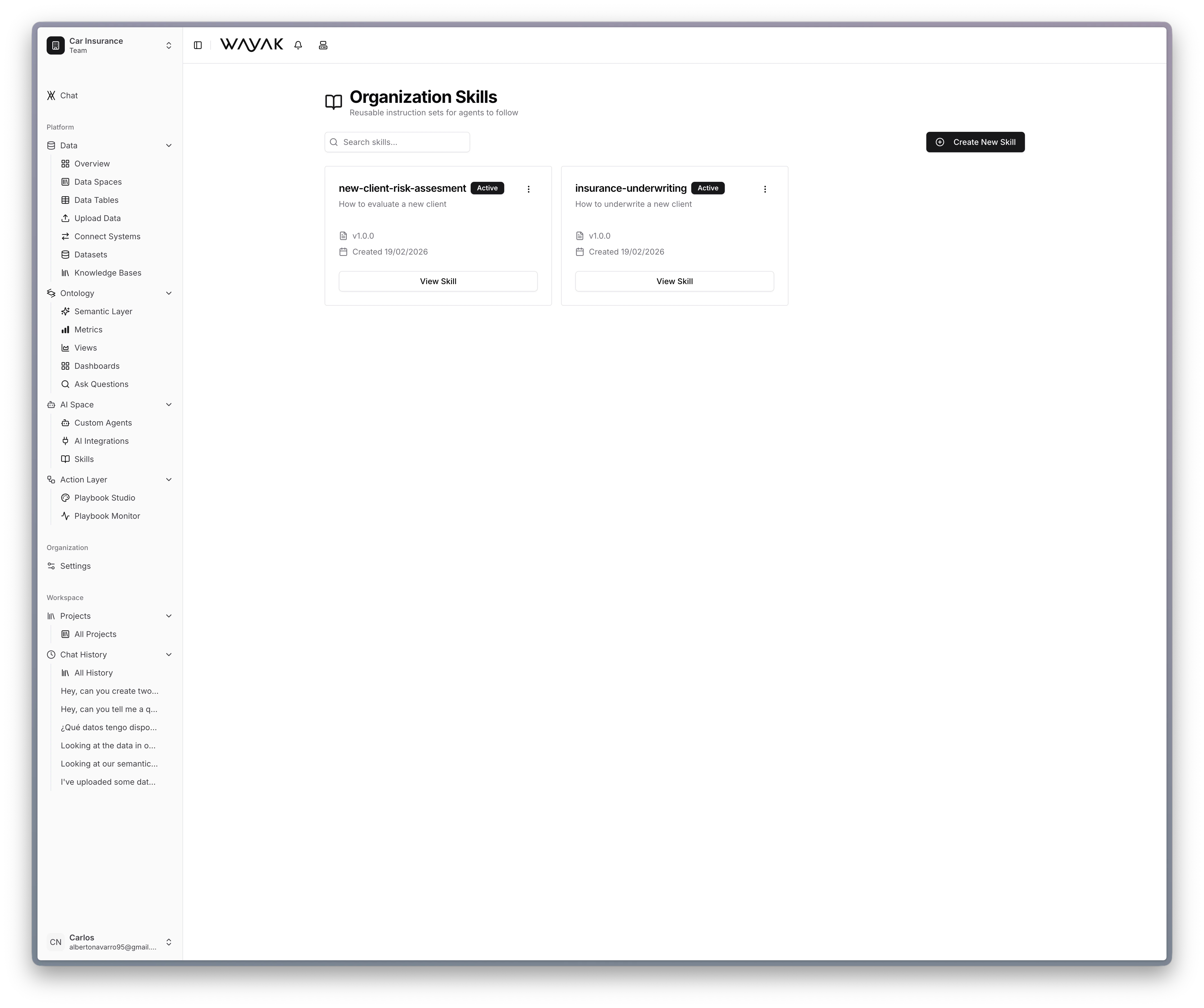 ## What a skill looks like
A skill is a markdown description with:
* **A name** — what the skill is called (e.g., "Calculate work order variance")
* **A trigger** — how the skill gets activated (user request, keyword, scheduled)
* **Instructions** — step-by-step procedural guidance in plain language
* **Output** — what the agent returns or delivers
The instructions are the core of a skill. They read like a procedure manual — clear, specific, and actionable.
## Example
Here is what a skill definition looks like in practice:
**Name:** Calculate work order variance
**Trigger:** User asks about production cost variance or work order costs
**Instructions:**
> 1. Identify the work order number from the user's request.
> 2. Pull the **estimated cost** from the work order header (planned labor + planned materials + planned overhead).
> 3. Pull the **actual cost** by summing all posted transactions against the work order (actual labor hours x rate, actual material issues, applied overhead).
> 4. Calculate the variance: actual cost minus estimated cost.
> 5. Break the variance into three categories: labor variance, material variance, and overhead variance.
> 6. If the total variance exceeds 10%, flag it and list the top contributing line items.
> 7. Present results in a table with estimated, actual, and variance columns.
**Output:** A variance summary table with a flag if the variance exceeds the threshold.
Notice how the skill is purely procedural — it doesn't define what a "work order" is (that's the ontology's job) or how to talk to the user (that's the agent's persona). It only describes *how to calculate the variance*.
## More examples
| Skill | What it does |
| ---------------------- | --------------------------------------------------------------------------------------------------------------- |
| Draft customer reply | Reads the incoming email, detects the issue type, and writes a response following the company's tone guidelines |
| Generate weekly report | Queries defined metrics, formats a summary, and delivers to a channel |
| Look up customer | Finds a customer across data sources and returns a consolidated profile |
| Create alert | Monitors a metric and notifies the team when a threshold is crossed |
## Skills vs. custom agents
A skill packages *how* to do something — the instructions for a specific task. A [custom agent](/concepts/agents/custom-agents) packages *who* is doing it — the persona, data access, and behavioral guidelines.
| | Skill | Custom agent |
| ---------------------------- | --------------------------------------------------------- | ---------------------------------------------------- |
| **Defines** | A procedure — *how* to perform a task | A persona — *who* the agent is |
| **Content** | Step-by-step instructions in markdown | Role, goal, tone, and behavioral guidelines |
| **Portability** | Assign to multiple agents | Each agent is a unique configuration |
| **Relationship to ontology** | Separate — uses ontology concepts but doesn't define them | Scopes which parts of the ontology the agent can see |
## Skills vs. playbooks
Skills are individual capabilities — a single action or short sequence. [Playbooks](/concepts/playbooks/what-is-a-playbook) are full automations that chain multiple skills and logic together into complex workflows.
Browse concrete agent and skill examples for manufacturing, customer service, insurance, and more.
## What a skill looks like
A skill is a markdown description with:
* **A name** — what the skill is called (e.g., "Calculate work order variance")
* **A trigger** — how the skill gets activated (user request, keyword, scheduled)
* **Instructions** — step-by-step procedural guidance in plain language
* **Output** — what the agent returns or delivers
The instructions are the core of a skill. They read like a procedure manual — clear, specific, and actionable.
## Example
Here is what a skill definition looks like in practice:
**Name:** Calculate work order variance
**Trigger:** User asks about production cost variance or work order costs
**Instructions:**
> 1. Identify the work order number from the user's request.
> 2. Pull the **estimated cost** from the work order header (planned labor + planned materials + planned overhead).
> 3. Pull the **actual cost** by summing all posted transactions against the work order (actual labor hours x rate, actual material issues, applied overhead).
> 4. Calculate the variance: actual cost minus estimated cost.
> 5. Break the variance into three categories: labor variance, material variance, and overhead variance.
> 6. If the total variance exceeds 10%, flag it and list the top contributing line items.
> 7. Present results in a table with estimated, actual, and variance columns.
**Output:** A variance summary table with a flag if the variance exceeds the threshold.
Notice how the skill is purely procedural — it doesn't define what a "work order" is (that's the ontology's job) or how to talk to the user (that's the agent's persona). It only describes *how to calculate the variance*.
## More examples
| Skill | What it does |
| ---------------------- | --------------------------------------------------------------------------------------------------------------- |
| Draft customer reply | Reads the incoming email, detects the issue type, and writes a response following the company's tone guidelines |
| Generate weekly report | Queries defined metrics, formats a summary, and delivers to a channel |
| Look up customer | Finds a customer across data sources and returns a consolidated profile |
| Create alert | Monitors a metric and notifies the team when a threshold is crossed |
## Skills vs. custom agents
A skill packages *how* to do something — the instructions for a specific task. A [custom agent](/concepts/agents/custom-agents) packages *who* is doing it — the persona, data access, and behavioral guidelines.
| | Skill | Custom agent |
| ---------------------------- | --------------------------------------------------------- | ---------------------------------------------------- |
| **Defines** | A procedure — *how* to perform a task | A persona — *who* the agent is |
| **Content** | Step-by-step instructions in markdown | Role, goal, tone, and behavioral guidelines |
| **Portability** | Assign to multiple agents | Each agent is a unique configuration |
| **Relationship to ontology** | Separate — uses ontology concepts but doesn't define them | Scopes which parts of the ontology the agent can see |
## Skills vs. playbooks
Skills are individual capabilities — a single action or short sequence. [Playbooks](/concepts/playbooks/what-is-a-playbook) are full automations that chain multiple skills and logic together into complex workflows.
Browse concrete agent and skill examples for manufacturing, customer service, insurance, and more.