

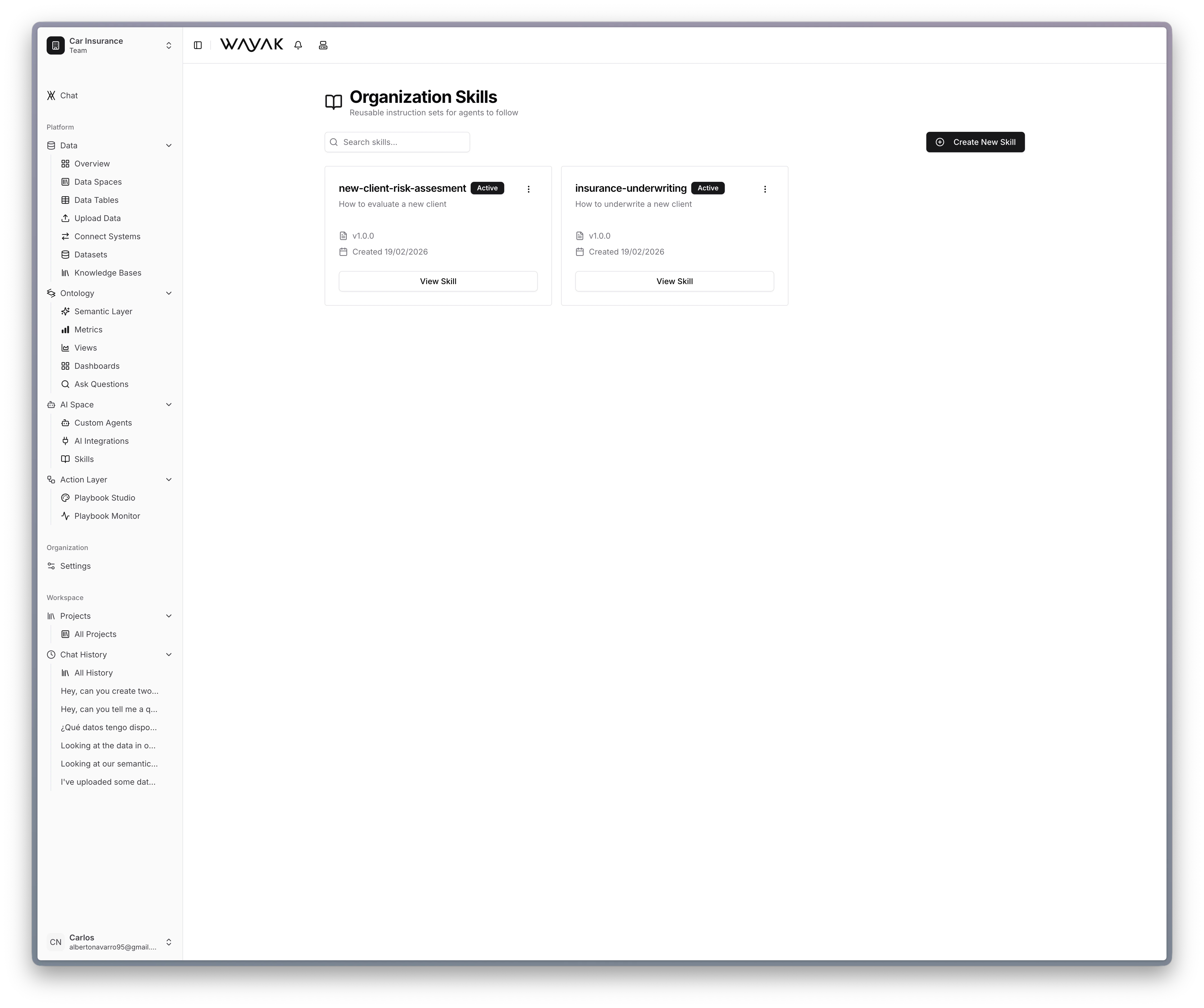
Manage reusable skills in the Wayak dashboard
What a skill looks like
A skill is a markdown description with:- A name — what the skill is called (e.g., “Calculate work order variance”)
- A trigger — how the skill gets activated (user request, keyword, scheduled)
- Instructions — step-by-step procedural guidance in plain language
- Output — what the agent returns or delivers
Example
Here is what a skill definition looks like in practice:Calculate work order variance
Calculate work order variance
Name: Calculate work order varianceTrigger: User asks about production cost variance or work order costsInstructions:
Output: A variance summary table with a flag if the variance exceeds the threshold.
- Identify the work order number from the user’s request.
- Pull the estimated cost from the work order header (planned labor + planned materials + planned overhead).
- Pull the actual cost by summing all posted transactions against the work order (actual labor hours x rate, actual material issues, applied overhead).
- Calculate the variance: actual cost minus estimated cost.
- Break the variance into three categories: labor variance, material variance, and overhead variance.
- If the total variance exceeds 10%, flag it and list the top contributing line items.
- Present results in a table with estimated, actual, and variance columns.
More examples
Skills vs. custom agents
A skill packages how to do something — the instructions for a specific task. A custom agent packages who is doing it — the persona, data access, and behavioral guidelines.Skills vs. playbooks
Skills are individual capabilities — a single action or short sequence. Playbooks are full automations that chain multiple skills and logic together into complex workflows.See examples by industry
Browse concrete agent and skill examples for manufacturing, customer service, insurance, and more.